When you choose jumper cables, length is a critical factor that affects both performance and convenience. Jumper cables that are too short might not reach safely between vehicles, making the jump-start process difficult and unsafe. On the other hand, cables that are too long can lead to voltage drops and make cable management cumbersome.
Understanding the ideal length for your vehicle type and parking situation helps ensure reliable power transfer without unnecessary clutter. Finding the right balance is essential for both safety and efficiency. But how do you determine the right length for your specific needs?
Key Takeaways
- Jumper cables typically range from 10 to 25 feet in length, accommodating various vehicle sizes and situations.
- Short cables (10 to 12 feet) reduce resistance but limit vehicle positioning flexibility.
- Longer cables (20 to 25 feet) offer greater reach but may cause voltage drop and durability concerns if thin.
- For tight parking spots, 12 to 16 feet cables are optimal to balance reach and reduce clutter.
- SUVs and trucks benefit from 16 to 20 feet cables to ensure adequate amperage and flexible connection.
Average Jumper Cable Lengths
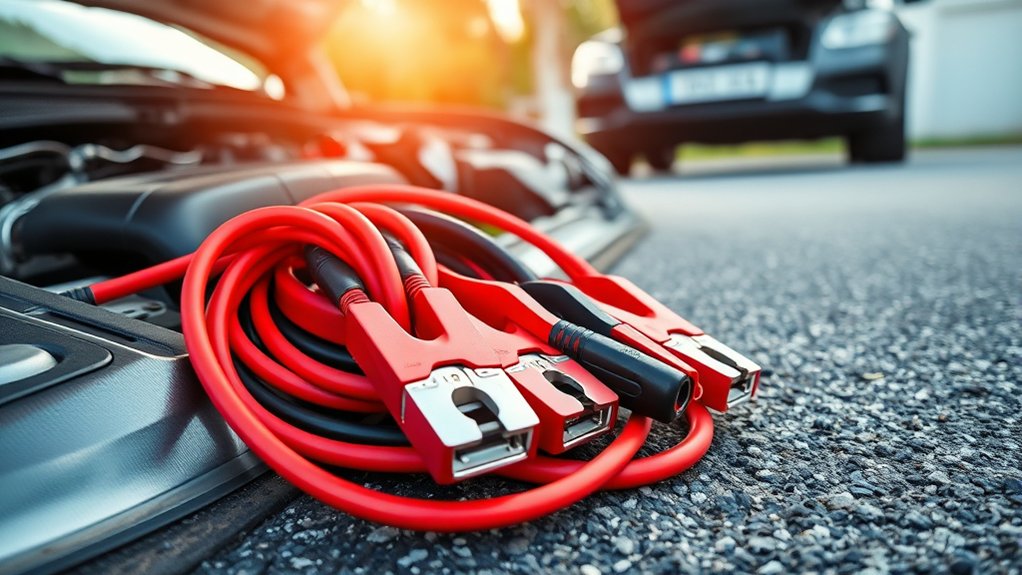
When selecting jumper cables, you’ll typically find lengths ranging from 10 to 25 feet. This range accommodates various scenarios while balancing cable durability and storage aesthetics.
Shorter cables, around 10 to 12 feet, offer improved cable durability due to less internal resistance and reduced risk of tangling, but they can be restrictive in vehicle positioning.
Longer cables, from 20 to 25 feet, provide greater flexibility in connecting vehicles but may compromise durability if the cable material is thin. Additionally, longer cables demand more attention to storage aesthetics since they require larger, more organized storage solutions to avoid damage and clutter.
Choosing the right length ensures you maintain cable integrity and keep your storage area neat without sacrificing functionality during use.
Why Jumper Cable Length Matters for Different Vehicles
Selecting the appropriate jumper cable length depends heavily on the type and size of the vehicles involved. Larger vehicles, like trucks and SUVs, often require longer cables to bridge greater distances between batteries, while compact cars typically need shorter cables.
Using cables that are too short may force you into awkward or unsafe positioning. Conversely, excessively long cables create unnecessary resistance and voltage drop, which can reduce jump-start effectiveness.
It’s an irrelevant topic to consider cable length without factoring in vehicle size because the electrical demands differ significantly. Avoid treating cable length as an extraneous concept; it directly impacts current flow and safety.
Matching cable length to your vehicle ensures efficient power transfer and safe operation during a jump-start, avoiding complications that stem from improper cable sizing.
Choosing the Right Jumper Cable Length for Tight Parking Spots
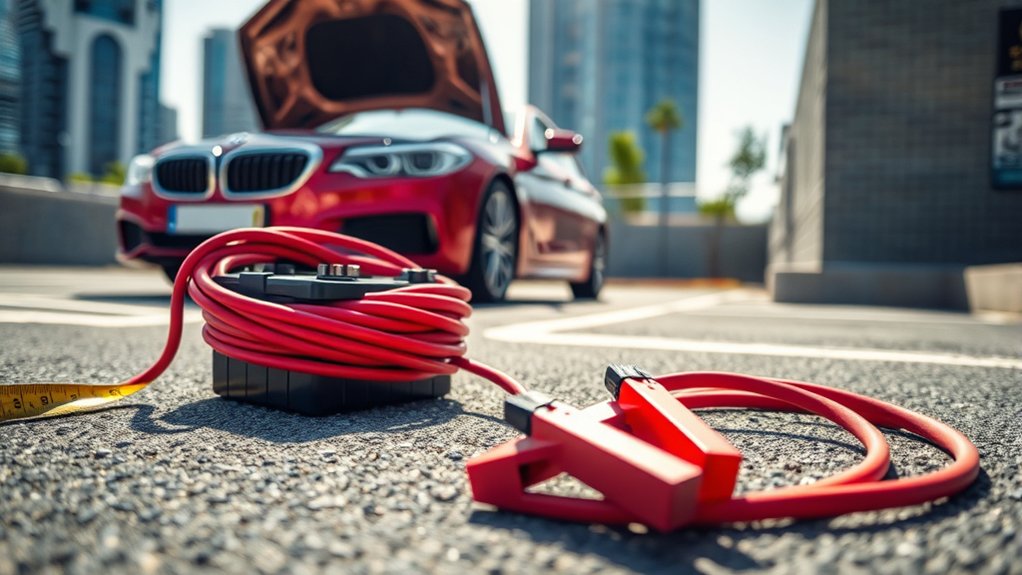
You’ll want to measure the available space between vehicles carefully to ensure your jumper cables reach without excess slack. Prioritize cables with good flexibility to maneuver easily in tight spots and avoid damage.
Typically, cables between 12 to 16 feet provide an optimal balance of length and manageability for most cramped parking situations.
Measuring Available Space
How do you determine the ideal jumper cable length for tight parking spots? Start by measuring the distance between the two vehicles’ batteries when parked as close as possible. Use a tape measure to gauge this gap, accounting for any obstacles that might force you to position vehicles slightly farther apart.
Short cables are often preferable in these scenarios because they reduce clutter and improve current flow efficiency, but they must be long enough to comfortably reach both batteries without strain. Conversely, long cables provide flexibility but can be cumbersome in confined spaces.
To balance convenience and functionality, measure carefully and choose a cable length that matches the available space with a small margin for maneuvering. Precise measurement ensures you avoid cables that are too short or excessively long for your parking situation.
Cable Flexibility Importance
Why does cable flexibility matter when choosing jumper cables for tight parking spots? When space is limited, you need cables that bend easily without kinking or stressing connections.
Flexibility metrics, such as bend radius and tensile strength, directly affect how well the cables maneuver around obstacles and fit confined areas. High-quality insulation plays a crucial role, too. It ensures that while the cable flexes repeatedly, the protective layer won’t crack or degrade, maintaining electrical safety and performance.
If insulation quality is poor, even flexible cables risk damage that compromises conductivity or causes shorts. So, when selecting jumper cables, prioritize those with superior flexibility metrics and robust insulation quality to guarantee reliable use in tight spaces and avoid frustrating, inefficient setups.
Optimal Length Recommendations
Where should you draw the line when picking jumper cable length for tight parking spots? You want cables long enough to reach between vehicles without strain, typically between 10 and 12 feet. This length balances flexibility with manageable storage and avoids excessive current loss.
Shortage awareness is essential. Longer cables can be scarce or costlier. Budgeting considerations also come into play; longer cables often mean higher prices and reduced efficiency due to voltage drop.
In confined spaces, overly long cables may tangle or create trip hazards. Consequently, select a length that guarantees reliable connectivity without unnecessary excess. Prioritize cables with adequate gauge to compensate for length, maintaining optimal power transfer.
This approach guarantees safety, efficiency, and convenience when jump-starting in tight parking spots.
How Cable Thickness Impacts Jumper Cable Performance
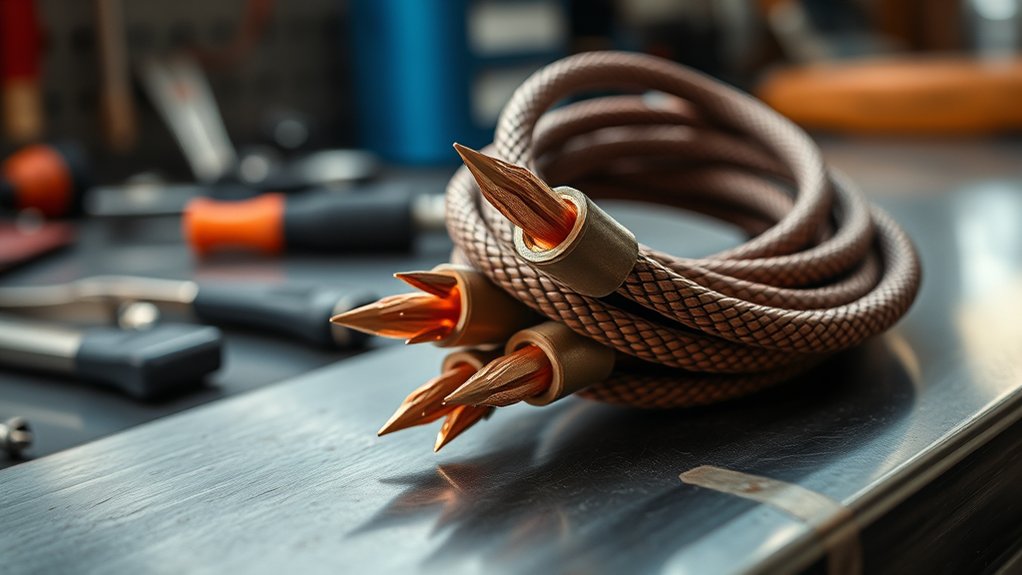
Cable thickness, measured in gauge, directly influences jumper cable performance by determining the amount of electrical current the cables can safely carry. Thicker cables, indicated by lower gauge numbers, reduce electrical resistance, allowing more current to flow efficiently, especially important when using long wires.
If the cables are too thin for the current required, the resistance increases, leading to voltage drops and overheating, which pose significant safety concerns. Using cables with insufficient thickness can cause the wires to heat up, potentially melting insulation or causing sparks.
Therefore, when selecting jumper cables, you need to consider both the cable gauge and length to ensure they handle your vehicle’s electrical demands safely. Choosing the right thickness minimizes energy loss and enhances reliability during jump-starting, maintaining safety and performance for all situations.
Pros and Cons of Short vs. Long Jumper Cables
Selecting the right length for your jumper cables can markedly affect their effectiveness and ease of use. Short cables offer lower electrical resistance, ensuring efficient current flow and faster engine starts. They’re easier to store and handle but require vehicles to be close, limiting flexibility in tight or obstructed spaces.
Long cables provide greater reach, allowing you to connect vehicles parked at a distance or in awkward positions. However, long cables increase resistance, which can reduce current flow and prolong the jump-start process. They’re also heavier and more cumbersome to manage.
When choosing between short cables and long cables, consider your typical usage scenarios: prioritize low resistance and convenience with short cables, or versatility and reach with long cables, balancing these factors for optimal performance.
Best Jumper Cable Lengths for SUVs and Trucks
How far apart do vehicles need to be when jump-starting an SUV or truck? Typically, you’ll want them close enough for jumper cables to reach comfortably without stretching or kinking.
For SUVs and trucks, the best jumper cable lengths range between 16 to 20 feet. This length gives you enough flexibility to connect battery terminals safely despite the larger vehicle size and higher engine compartments.
Using cables that are too short limits your positioning options, while excessively long cables can cause voltage drop, reducing effectiveness.
Subtopic idea1 emphasizes selecting cables with adequate gauge thickness to handle higher amperage demands common in bigger engines.
Subtopic idea2 highlights that 16-20 feet balances reach and power delivery, ensuring efficient and safe jump-starts for SUVs and trucks without unnecessary cable clutter.
How to Store and Manage Long Jumper Cables Easily
You’ll want to coil your long jumper cables using a consistent method to prevent tangling and damage. Invest in compact storage solutions like cable reels or dedicated pouches to keep them organized and accessible.
Proper management extends the cables’ lifespan and guarantees quick deployment during emergencies.
Effective Cable Coiling
Where’s the best place to start when storing long jumper cables to prevent tangling and damage? Begin with effective cable coiling. Use the over-under method to maintain cable integrity, minimizing twists and stress on internal wires.
This technique supports both short term planning and long term budgeting by extending cable life and reducing replacement frequency. Avoid tight loops that cause kinks; instead, coil cables loosely to preserve flexibility. Secure the coil with a Velcro strap or cable tie to prevent unraveling.
Proper coiling also simplifies deployment, saving time during emergencies. By adopting precise coiling habits, you manage your jumper cables efficiently, balancing immediate usability with the cables’ longevity. This approach reinforces maintenance routines and cost-effectiveness in your automotive toolkit.
Compact Storage Solutions
When managing long jumper cables, choosing the right storage method can substantially reduce clutter and enhance accessibility. To store cables compactly, coil them tightly using a consistent technique, then secure with Velcro straps or reusable cable ties.
Avoid tossing cables loosely into your vehicle’s trunk or toolbox, as this introduces irrelevant topic clutter and increases the risk of damage. Consider dedicated storage solutions like molded cases or wall-mounted hooks designed specifically for jumper cables.
These options prevent stray concept tangling and simplify retrieval under emergency conditions. Additionally, labeling storage containers helps maintain organization and prevents confusion with other automotive tools.
Where to Find Reliable Jumper Cables in the Right Length
How can you guarantee the jumper cables you purchase meet both reliability and length requirements? Start by checking specialized automotive stores, where staff can guide you without using non technical jargon. These stores typically offer cables tested for durability and proper gauge, ensuring safe current flow.
Online retailers provide detailed specifications, allowing you to compare lengths and quality efficiently. If you have budget constraints, prioritize cables with thicker wires and secure clamps; they may cost more upfront but last longer and perform better.
Avoid generic or unbranded cables that lack clear technical data. Additionally, read customer reviews to confirm real-world reliability. By focusing on trusted sources and clear product details, you’ll find jumper cables that fit your vehicle’s needs precisely and safely, without overspending.
Frequently Asked Questions
Can Jumper Cables Damage My Car’s Electrical System?
Yes, improper use of jumper cables can damage your car’s electrical system. To prevent this, always follow electrical safety guidelines and guarantee correct cable connections.
Avoid reversing polarity when jump-starting your vehicle.
How Do I Safely Connect Jumper Cables Step-By-Step?
You connect jump cables by attaching the red clamp to the dead battery’s positive terminal, then the other red to the good battery’s positive.
Next, connect black to the good battery’s negative and last black to grounded metal on the dead car, following safety steps.
What Are the Signs of Faulty Jumper Cables?
Over 30% of jumper cables fail due to corrosion. You’ll spot signs of wear like frayed wires or cracked insulation.
Use cable testing to check conductivity and resistance, ensuring safe, reliable performance before every jump-start attempt.
Can Jumper Cables Be Used in Extreme Weather Conditions?
Yes, you can use jumper cables in extreme weather if their cable insulation is high-quality and rated for low temperatures. Poor insulation may crack or fail, so always check for durability before relying on them in harsh conditions.
How Often Should Jumper Cables Be Replaced?
You should replace jumper cables every 3-5 years or when insulation wears out. Check wearable accessories regularly, ensuring compatibility with your battery types to maintain safe, efficient performance during jump-starts in various conditions.
Conclusion
Choosing the right jumper cable length is like selecting the perfect bridge—you need enough span to connect safely without unnecessary slack causing power loss or clutter. For tight parking spots, shorter cables offer efficient power delivery and easier handling.
Longer cables suit larger vehicles but may reduce performance if too lengthy. By balancing length, thickness, and your vehicle’s size, you ensure reliable jumps every time.
Understanding how long are jumper cables helps you avoid frustration and maximize safety on the road.