You might think you can charge a battery with jumper cables, but that’s not quite how they work. Jumper cables transfer a quick burst of power from another battery to start your engine, relying on your alternator to slowly restore the charge afterward.
This method doesn’t regulate current or voltage, so it’s not sufficient for deeply discharged batteries. Understanding this distinction is vital before you try to rely on jumper cables alone.
Key Takeaways
- Jumper cables provide a rapid current surge to start a dead battery but do not deliver a sustained charge to fully recharge it.
- They create a temporary conductive path, enabling the alternator to recharge the battery once the engine runs.
- Jumper cables do not regulate voltage or current, making them unsuitable for safe, full battery charging.
- Using jumper cables alone for charging risks battery damage and reduced lifespan without proper charging equipment.
- For complete and safe battery restoration, a dedicated battery charger and controlled charging process are necessary.
How Do Jumper Cables Transfer Power?
How exactly do jumper cables transfer power between two batteries? When you connect jumper cables, you create a conductive path that allows electrical current to flow from the charged battery to the dead one.
How jumper cables work involves attaching the red clamp to the positive terminals and the black clamp to the negative terminals or an engine ground. This setup completes the circuit, enabling power transfer via the cables’ metal conductors.
The current flows through the cables, overcoming internal resistance in the dead battery, which helps restore enough charge to start the engine. The cables must have sufficient gauge to handle the high current without significant voltage drop, ensuring efficient power transfer during the jump-start process.
Why Is Jump-Starting Different From Charging?
Why does jump-starting a battery differ from charging it? When you jump start vs charging, you’re addressing fundamentally different processes. Jump-starting delivers a rapid, high-current burst from a donor battery to power the dead battery’s starter motor, enabling the engine to run. Charging, however, involves a controlled, gradual flow of electrical current to restore the battery’s chemical energy over time.
You must recognize the safety vs risk balance here. Jump-starting carries higher risks. Incorrect connections can cause sparks, damage electronics, or battery explosions. Charging, done properly, is safer but requires an appropriate charger and time. Understanding this distinction helps you manage expectations and handle batteries correctly, minimizing hazards while ensuring your vehicle regains power effectively.
Can Jumper Cables Charge a Dead Battery?
You can use jumper cables to transfer electrical current from a charged battery to a dead one, enabling a quick start. However, jumper cables alone don’t provide a sustained charge to fully recharge the dead battery.
Understanding their function and limitations helps you avoid relying on them as a permanent charging solution.
How Jumper Cables Work
Wondering if jumper cables can actually charge a dead battery? Jumper cables transfer electrical current from a charged battery to a dead one by connecting their terminals. When you clamp the positive and negative ends correctly, you complete an electrical circuit, allowing current to flow.
This flow temporarily powers the dead battery’s chemical processes, which rely on battery chemistry involving lead-acid or lithium-ion cells. However, jumper cables don’t directly charge the battery; they provide a surge of electricity to start the engine, enabling the vehicle’s alternator to resume proper charging.
Always observe charging safety by ensuring proper cable connections and avoiding sparks, which can ignite explosive gases near the battery. Understanding this process helps you use jumper cables effectively and safely.
Limitations Of Charging Dead Batteries
How effective are jumper cables at charging a dead battery? Jumper cables primarily provide a temporary boost by connecting your dead battery to a live one, supplying sufficient current to start your vehicle. However, they don’t fully recharge the dead battery.
The charging limitations stem from the cables’ role: they transfer power but don’t regulate voltage or current for optimal charging. Once your engine runs, the alternator takes over, gradually recharging the battery.
If the battery is severely discharged or internally damaged, jumper cables won’t restore its capacity. Additionally, relying solely on jumper cables without proper charging can reduce battery lifespan.
Better Charging Methods Than Jumper Cables
A more effective approach to charging a battery than using jumper cables involves dedicated battery chargers and portable power packs. These devices provide controlled voltage and current, reducing the risk of damage caused by the abrupt power surge typical with jumper cables.
If you rely solely on jumper cables, you face insufficient safety measures, including potential sparks or reverse polarity issues. Alternative charging methods, such as smart chargers, offer automatic regulation and desulfation modes that prolong battery life.
Portable power packs combine convenience with precision, allowing you to charge batteries without another vehicle. Using these tools ensures a safer and more reliable charge, especially if the battery is deeply discharged or old.
In comparison, jumper cables are best as a temporary jump-start, not a proper charging solution.
How to Safely Use Jumper Cables
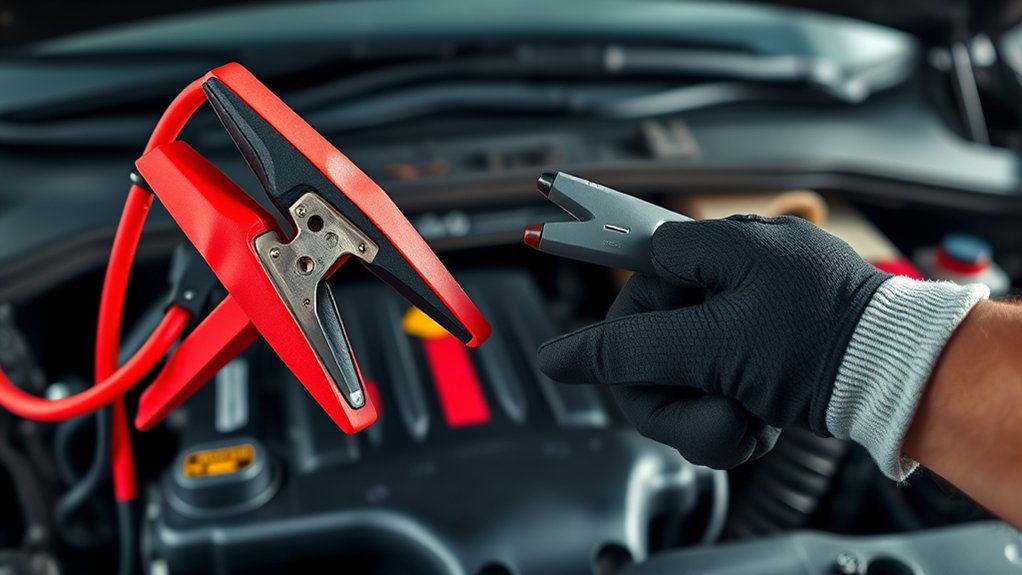
When connecting jumper cables, you must follow a specific sequence to prevent sparks or damage to either vehicle’s electrical system. Prioritize charging safety by adhering to these steps:
Proper jumper cable connection order is essential to avoid sparks and protect both vehicles’ electrical systems.
- Attach the red clamp to the positive terminal (+) of the dead battery.
- Connect the other red clamp to the positive terminal (+) of the good battery.
- Attach the black clamp to the negative terminal (–) of the good battery.
- Connect the last black clamp to an unpainted metal surface on the dead car’s engine block, away from the battery.
This sequence reduces the risk of sparks and electrical shorts. In cold weather issues, ensure clamps have a secure grip as metal contracts, possibly reducing contact quality.
Always wear safety glasses and gloves to protect from acid or sparks during the process.
Troubleshooting Common Jumper Cable Problems
You might encounter cable connection issues if the clamps don’t grip the battery terminals firmly or if corrosion interferes with conductivity. It’s also essential to verify battery compatibility, since mismatched voltages or damaged batteries can prevent successful charging.
Addressing these problems guarantees a safer and more effective jump-start process.
Cable Connection Issues
Why won’t your jumper cables work as expected? Cable connection issues often cause poor performance or failure. To troubleshoot effectively, consider these key points:
1. Check cable gauge
Thin cables can’t handle high current, causing voltage drops and ineffective charging. Use cables rated for your vehicle’s battery.
2. Inspect clamps
Ensure clamps are clean, corrosion-free, and tightly connected to battery terminals.
3. Confirm correct polarity
Attach red clamps to positive (+) terminals and black clamps to negative (−) terminals to prevent damage.
4. Wear safety gear
Protect yourself with gloves and eye protection to safely handle connections and avoid sparks.
Proper connections and equipment quality are vital for jumper cables to function safely and efficiently.
Battery Compatibility Challenges
How do you guarantee jumper cables work effectively across different battery types? First, assess the battery metrics: voltage, amp-hour capacity, and chemistry (lead-acid, AGM, or gel). Using jumper cables designed for the vehicle’s specific battery voltage (typically 12V) ensures compatibility.
Mismatched voltages can cause charging inefficiency or damage. Pay close attention to polarity; reversing connections risks sparks or battery failure. To maintain charging safety, avoid connecting incompatible batteries, as this can lead to overheating or acid leakage.
Also, confirm the cable gauge matches the required current load; thinner cables may overheat under high amperage demands. By precisely matching battery metrics and following proper connection protocols, you can troubleshoot common jumper cable problems and optimize charging safety across diverse battery types.
Frequently Asked Questions
Can Jumper Cables Damage My Car’s Electrical System?
Yes, improper jumper cables safety can damage your car’s electrical system. Incorrect connections or using low-quality cables increase electrical system risks, potentially causing voltage spikes, blown fuses, or damage to sensitive electronics.
Always follow proper procedures.
What Type of Jumper Cables Is Best for My Vehicle?
Wondering which jumper cables ensure orderly charging and battery safety? You’ll want heavy-gauge cables (4-6 gauge) with insulated clamps to minimize resistance and risk, guaranteeing efficient current flow while protecting your vehicle’s electrical system.
How Long Should I Leave Jumper Cables Connected?
You should leave jumper cables connected for about 3 to 5 minutes to allow enough charge transfer. Prioritize connection safety by ensuring clamps are secure and cables aren’t touching, preventing sparks or damage during this time.
Can I Jump-Start a Motorcycle With Jumper Cables?
Yes, you can jump-start a motorcycle with jumper cables, but be cautious of voltage differences. Discussing unrelated issues or irrelevant topics like charging techniques doesn’t help; focus strictly on proper connection and safety precautions for effective jump-starting.
Are There Any Alternatives to Jumper Cables for Emergency Starting?
You’ve got a few handy tricks up your sleeve for emergency power: portable jump starters, solar battery chargers, and battery booster packs. These alternative methods deliver reliable, efficient power quickly when jumper cables aren’t an option.
Conclusion
You can use jumper cables to jump-start your battery, to boost your engine start, and to get your vehicle running.
But don’t rely on jumper cables to charge your battery fully, to restore deep discharges, or to replace a proper charger.
Instead, use jumper cables safely, monitor your battery’s health, and choose dedicated charging methods for long-term power.
Following these steps ensures reliable starts, controlled charging, and optimal battery life.
In conclusion, while jumper cables are useful for quick boosts, they are not suitable to charge a battery with jumper cables fully over time.