Imagine you’re troubleshooting a car engine that struggles to deliver smooth power despite perfectly functioning pistons. The crankshaft, a critical component, often plays a key role in this issue. It converts the pistons’ up-and-down motion into rotational energy needed to drive the vehicle.
Without a properly balanced and durable crankshaft, engine performance and longevity suffer substantially. Understanding its design and operation is essential for diagnosing such problems. This knowledge helps ensure optimal engine function and reliability.
Key Takeaways
- A crankshaft converts the pistons’ linear motion into rotational motion to power a vehicle’s engine.
- It supports engine balance using counterweights and journals to reduce vibrations and stress.
- The crankshaft connects to pistons via crankpins, translating reciprocating force into torque.
- Made from materials like forged steel or cast iron, it withstands immense forces and wear.
- It acts as the engine’s mechanical heart, synchronizing components for smooth and efficient operation.
What Is a Crankshaft and What Does It Do
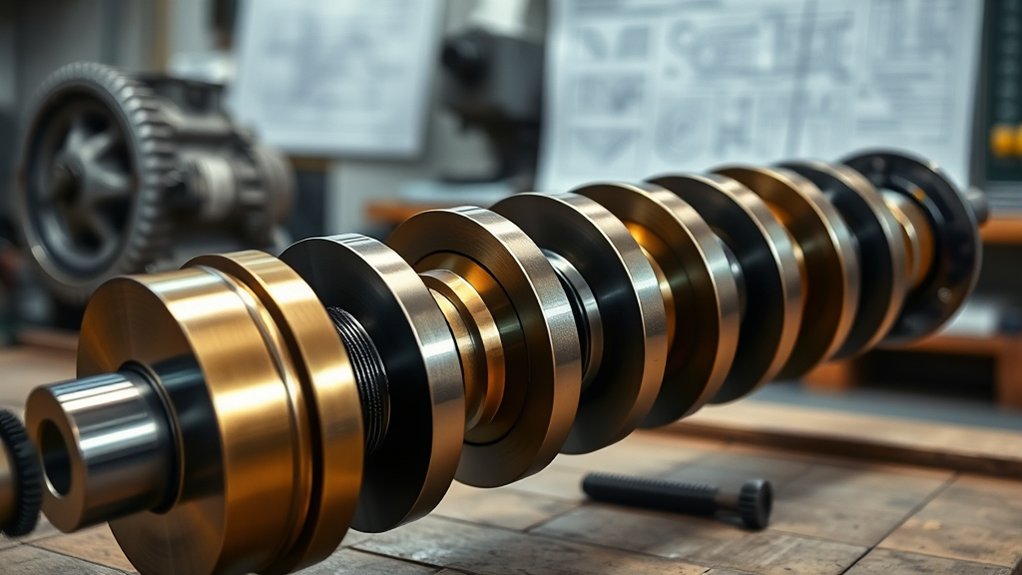
A crankshaft is a critical mechanical component that converts the linear motion of pistons into rotational motion necessary to power a vehicle. When you examine the crankshaft history, you’ll find it evolved from early steam engines to modern internal combustion engines, highlighting its fundamental role in automotive engineering.
Contrary to some automotive myths, the crankshaft isn’t just a simple rotating shaft; it’s a precisely engineered part designed to withstand immense forces and vibrations. You rely on its counterweights and journals to maintain balance and reduce stress on the engine.
Understanding the crankshaft’s function and design helps you appreciate how it directly influences engine performance, durability, and efficiency. It’s the heart of your engine’s mechanical operation, integral to converting energy into motion effectively.
How Crankshafts Convert Piston Motion Into Rotation
You’ll see that as the piston moves up and down in a linear path, the crankshaft translates this motion into rotational energy. The crankshaft’s offset journals convert the reciprocating force into torque on the shaft.
Understanding this mechanical interaction is key to grasping how engines generate continuous rotation from piston cycles.
Piston Movement Mechanics
How does a crankshaft transform the linear motion of pistons into rotational energy? The process hinges on the precise interaction between piston motion and crankshaft timing.
As the piston moves linearly within the cylinder during combustion, it exerts force on the connecting rod. This rod links the piston to the crankshaft’s offset journals. The crankshaft timing ensures these journals rotate in sync with the piston’s reciprocating motion, converting that linear force into torque.
The offset nature of the journals means that as the piston moves down, it causes the crankshaft to rotate incrementally. This conversion relies on the exact synchronization of piston position and crankshaft angle, which the crankshaft timing system governs, allowing smooth and efficient energy transformation with minimal mechanical loss.
Rotational Energy Transfer
Where does the linear force from the piston go once it pushes down? It transfers to the crankshaft, which converts this reciprocal, linear motion into rotational energy. The crankshaft’s offset crankpins act as levers, translating the piston’s up-and-down force into torque around the main axis.
This rotational energy transfer is fundamental to engine operation, enabling the conversion of combustion power into usable rotational motion to drive the vehicle. Don’t fall for common crankshaft myths that oversimplify this process; it’s not merely a rigid rod spinning but a precisely engineered mechanism managing complex forces.
Understanding this energy transfer clarifies how the crankshaft integrates piston motion dynamically, maintaining engine balance and efficiency while delivering consistent rotational output critical for drivetrain performance.
The Crankshaft’s Role in Engine Operation
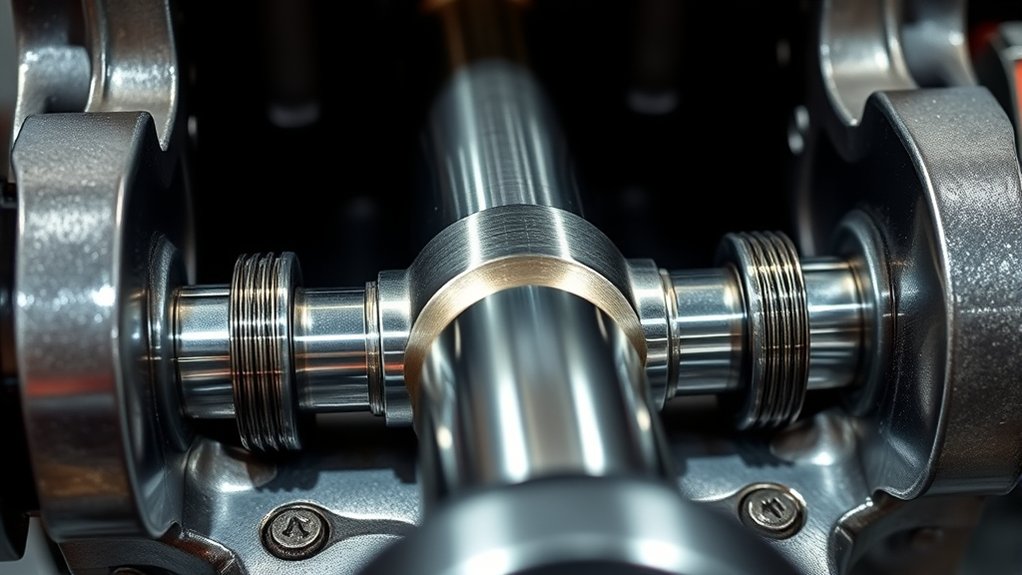
Why does the crankshaft matter so much in engine operation? You rely on it to convert the pistons’ linear motion into rotational energy essential for powering your vehicle. This conversion is critical for synchronizing engine components and delivering smooth torque output.
While crankshaft aesthetics and cosmetic finishes might catch your eye, their primary purpose is structural integrity and precise balance. Any imperfections can cause vibrations, reducing efficiency and lifespan.
You’ll find that the crankshaft’s role extends beyond mere rotation; it absorbs and mitigates dynamic forces generated during combustion cycles. By understanding this, you appreciate how integral the crankshaft is, not just a mechanical part, but the engine’s core facilitator ensuring consistent performance and durability under demanding conditions.
Main Parts of a Crankshaft and How They Work
The crankshaft’s ability to convert piston movement into rotational force depends on its carefully engineered components. Each part works in unison, ensuring smooth power transmission while relying on proper engine lubrication and crankcase ventilation to maintain efficiency and reduce wear.
| Part | Function | Relation to System |
|---|---|---|
| Main Journals | Support crankshaft rotation | Interface with engine block |
| Crankpins | Connect to connecting rods | Convert reciprocating motion |
| Counterweights | Balance rotational forces | Reduce vibration |
| Crank Webs | Connect journals and crankpins | Structural integrity |
| Oil Passages | Deliver lubrication to moving parts | Ensure minimal friction |
Understanding these parts helps you appreciate how lubrication and ventilation maintain crankshaft performance and engine longevity.
Materials That Make Crankshafts Durable
How do crankshafts withstand the immense stresses of engine operation without failing? The answer lies in the selection of crankshaft materials and their durability factors. Manufacturers prioritize materials that offer optimal strength, fatigue resistance, and wear properties.
Key crankshaft materials and durability factors include:
- Forged Steel: Provides high tensile strength and toughness, resisting fatigue under cyclic loads.
- Cast Iron: Offers good wear resistance and vibration damping but is less durable under extreme stress.
- Nodular Iron: Enhances strength and ductility compared to standard cast iron, improving fatigue life.
- Surface Treatments (e.g., nitriding): Increase hardness and reduce surface wear, extending service life.
Common Signs Your Crankshaft Is Failing
When should you be concerned that your crankshaft is failing? Pay close attention if you notice unusual engine vibrations, knocking noises, or difficulty starting. These symptoms often indicate crankshaft misalignment or bearing wear.
Additionally, metal shavings in the oil suggest internal damage, while decreased engine performance signals compromised rotational stability. Ignoring these signs risks severe engine failure.
While crankshaft humor might joke about “a twist in the plot,” the reality is far from amusing. Your crankshaft converts piston poetry—the rhythmic motion of pistons—into rotational energy; any disruption here undermines engine efficiency.
Monitoring these indicators proactively allows you to address issues before catastrophic failure, ensuring your engine maintains optimal function and longevity.
How Crankshafts Are Manufactured and Balanced
Recognizing the signs of crankshaft failure highlights the importance of its precise manufacturing and balancing processes. You’ll find that crankshaft materials, typically forged steel or cast iron, are selected for strength and fatigue resistance.
Understanding crankshaft failure underscores the need for precise manufacturing and durable, fatigue-resistant materials.
The manufacturing processes involve multiple critical steps to ensure durability and performance:
- Forging or casting the raw crankshaft blank from high-grade crankshaft materials.
- Precision machining to achieve exact dimensions and surface finish.
- Heat treatment to enhance hardness and wear resistance.
- Dynamic balancing to correct mass distribution and minimize vibrations.
Each step demands strict quality control. Balancing ensures the crankshaft rotates smoothly, preventing premature wear and engine damage. By understanding these manufacturing processes, you appreciate how critical accuracy is in producing a reliable crankshaft.
Why Maintaining Your Crankshaft Keeps Your Engine Healthy
You need to maintain your crankshaft to prevent wear and tear that can cause imbalances and damage engine components. Regular inspections and proper lubrication guarantee the crankshaft operates within design tolerances.
This upkeep directly supports optimal engine performance and longevity.
Preventing Wear And Tear
Regularly maintaining your crankshaft substantially reduces wear and tear, preserving engine performance and longevity. You’ll want to focus on these critical actions to prevent damage:
- Monitor for strange vibrations, as they indicate misalignment or bearing wear.
- Ensure consistent crankcase oiling to minimize friction and heat buildup.
- Inspect journals and bearing surfaces regularly for scoring or pitting.
- Replace seals and gaskets as needed to prevent oil leaks and contamination.
Ensuring Optimal Engine Performance
How exactly does maintaining your crankshaft contribute to peak engine performance? By ensuring the crankshaft remains free of defects and properly balanced, you prevent vibrations that compromise engine efficiency.
Regular engine diagnostics detect imbalances or wear that affect the crankshaft’s rotational accuracy. Addressing issues early minimizes stress on bearings and connecting rods, preserving structural integrity.
Additionally, attending to crankshaft cosmetics, such as removing corrosion and polishing journals, reduces friction and wear, directly enhancing engine responsiveness. Neglecting these maintenance steps can lead to uneven power delivery and increased fuel consumption.
Frequently Asked Questions
Can a Crankshaft Be Repaired or Only Replaced?
You can repair a crankshaft if damage is minimal and materials like forged steel allow machining. However, extensive wear often requires replacement, making repair vs replacement a cost-effective, precision-driven decision based on crankshaft materials and damage severity.
How Does Crankshaft Design Differ in Electric Vehicles?
You’ll find EV crankshaft designs symbolize silence and efficiency, using advanced crankshaft materials to minimize weight and optimize vibration reduction. This contrasts traditional designs, prioritizing smooth energy transfer without the intense mechanical stress of combustion engines.
What Tools Are Needed to Inspect a Crankshaft?
You’ll need inspection tools like micrometers, dial indicators, and magnetic particle testers. Measurement methods include straightness checks and wear analysis.
Understanding repair options helps, especially since crankshafts appear in non-automotive applications too.
How Does Crankshaft Weight Affect Engine Performance?
You’ll find crankshaft weight directly impacts engine performance by influencing rotational inertia. Maintaining tight manufacturing tolerances and optimizing crankshaft aesthetics ensures balance, reducing vibrations and improving efficiency.
This results in smoother power delivery and enhanced durability.
Are Crankshafts Used in Non-Automotive Machinery?
Yes, crankshaft applications extend to non-automotive machinery, including industrial compressors, marine engines, and agricultural equipment.
You’ll find they convert linear piston motion into rotational energy, optimizing mechanical efficiency and performance beyond automotive uses.
Conclusion
Your crankshaft is like the engine’s heartbeat, converting piston motion into smooth rotation essential for power delivery. If it’s damaged or unbalanced, you risk severe engine inefficiency or failure.
By understanding its parts, materials, and maintenance needs, you can guarantee durability and optimal performance. Keep it well-lubricated and monitored—doing so protects your engine’s core, preserving its precision and longevity for reliable operation under high stress.
Proper care and regular maintenance of the crankshaft ensure the engine runs smoothly and efficiently. This attention not only extends the life of your engine but also maximizes the crankshaft’s performance in every cycle.