You might think a cam shaft is just a simple rotating part, but it actually plays a critical role in your engine’s performance by precisely timing valve movements.
It converts rotational motion into linear action, ensuring valves open and close at exactly the right moments in sync with piston position.
Understanding how this component governs intake, exhaust, and combustion efficiency is key to grasping why it demands careful attention and maintenance.
Key Takeaways
- A camshaft controls the timing and duration of engine valve openings by rotating lobes that push valve lifters or rocker arms.
- It converts rotational motion from the crankshaft into linear valve movement for precise air-fuel intake and exhaust gas expulsion.
- The camshaft synchronizes valve operation with piston movement via a timing belt or chain, ensuring efficient combustion and engine performance.
- Camshaft lobes require continuous lubrication to reduce friction, prevent wear, and maintain accurate valve timing.
- Different camshaft profiles and types affect engine power, torque, fuel efficiency, and emissions by optimizing valve timing and lift.
What Is a Cam Shaft and Why It Matters
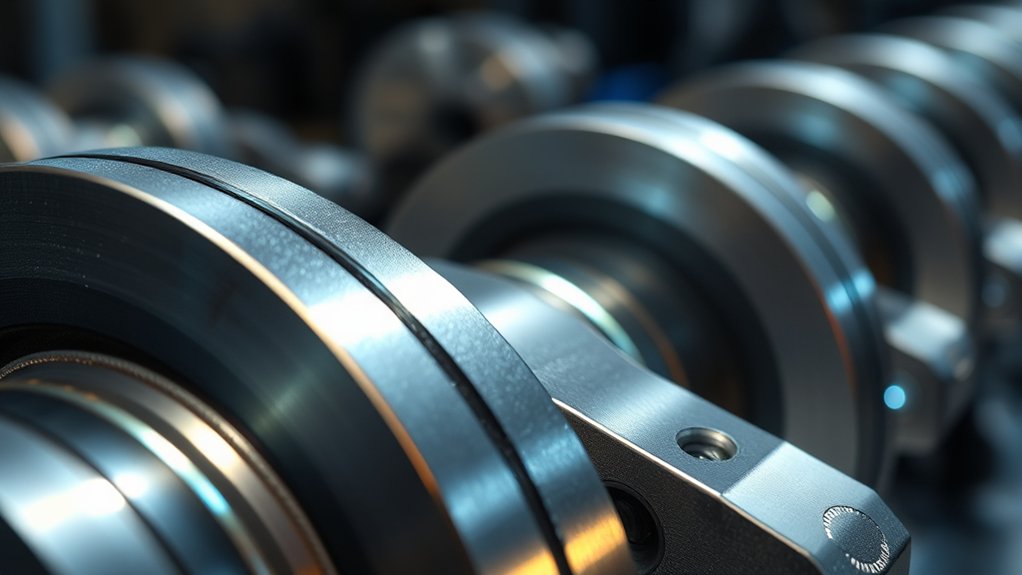
What exactly is a cam shaft, and why should you care about its role in an engine? The cam shaft is a rotating component responsible for precise timing of mechanical movements within an engine. It features lobes that push against other parts to enable engine functions.
You need to understand cam shaft durability because it directly affects engine longevity and performance. These shafts endure constant stress and high temperatures, challenging their structural integrity.
Lubrication challenges arise because the cam shaft’s surfaces require consistent oil flow to minimize friction and wear. Without optimal lubrication, the metal-to-metal contact increases, accelerating degradation.
Therefore, maintaining cam shaft durability depends heavily on addressing lubrication challenges effectively, ensuring the engine operates smoothly and reliably over time.
How Does a Cam Shaft Control Engine Valves?
Understanding the cam shaft’s durability and lubrication needs sets the stage for grasping how it precisely controls engine valves. The camshaft, typically crafted from hardened steel or cast iron, must withstand constant mechanical stress and friction.
Its lobes rotate, pushing against valve lifters or rocker arms, which open and close the valves at specific intervals. Because the camshaft operates under high pressure and speed, lubrication challenges arise, requiring a consistent oil film to minimize wear and heat buildup.
The camshaft material’s hardness and surface finish directly impact its ability to maintain precise valve timing without deforming. Proper lubrication ensures smooth lobe rotation and prevents metal-to-metal contact, enabling the camshaft to reliably convert rotational motion into the linear motion needed to control engine valve operation efficiently.
The Role of Cam Shafts in Engine Timing
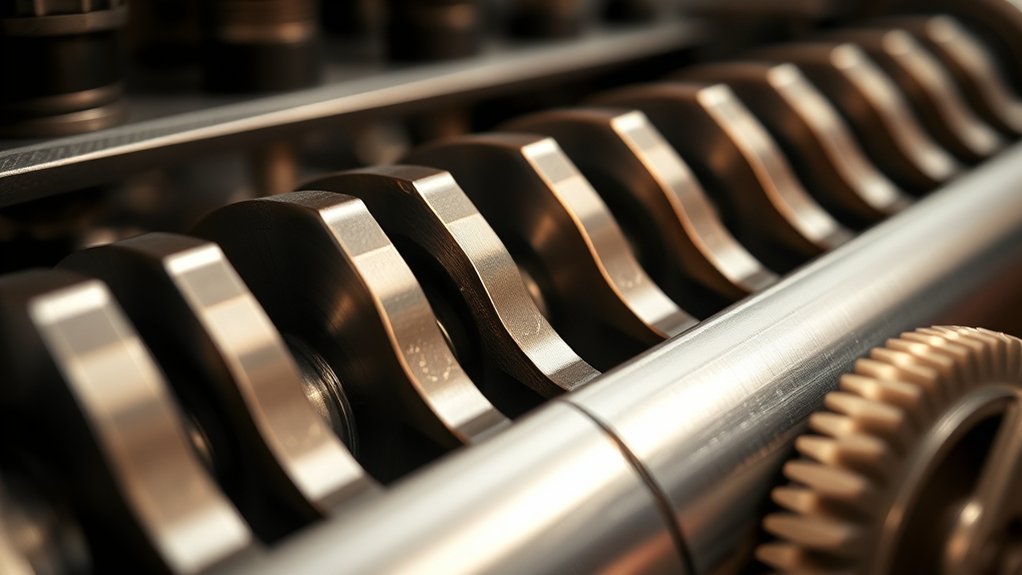
How exactly does the camshaft influence engine timing? The camshaft controls the precise moments intake and exhaust valves open and close, synchronizing with the piston movement. Its design, heavily reliant on camshaft metallurgy, ensures durability under high stress and heat.
The timing belt interactions are critical here; the belt connects the camshaft to the crankshaft, maintaining exact rotational alignment. Any deviation causes mistimed valve events, reducing engine efficiency or causing damage.
| Component | Role in Timing |
|---|---|
| Camshaft metallurgy | Ensures wear resistance and accuracy |
| Timing belt | Synchronizes camshaft and crankshaft rotation |
| Valve events | Open and close precisely as pistons move |
You must monitor these elements to maintain optimal engine timing and performance.
Common Cam Shaft Types and Applications
You’ll encounter several camshaft types, including overhead camshaft variations like single and dual overhead cams, each designed for specific timing precision and engine performance.
Flat camshaft designs, often found in pushrod engines, provide a different mechanical setup tailored for compact or high-torque applications. Understanding these types helps you match camshaft designs to their engine uses and performance goals effectively.
Overhead Camshaft Variations
What distinguishes the various overhead camshaft designs, and why do manufacturers choose one over another? You’ll find single overhead camshafts (SOHC) and double overhead camshafts (DOHC) dominate modern engines.
SOHC setups simplify valve operation, reducing components and eliminating obsolete timing belts, which improves reliability. DOHC designs, with separate cams for intake and exhaust valves, provide enhanced valve timing control and higher RPM capabilities.
Both rely on precise non enzymatic lubrication to minimize wear and maintain efficient operation. Manufacturers select designs based on performance targets, complexity, and cost.
For instance, DOHC suits high-performance engines needing variable valve timing, while SOHC offers simplicity and durability for mass-market vehicles. Understanding these distinctions helps you appreciate the balance between efficiency, power, and maintenance in overhead camshaft variations.
Flat Camshaft Designs
Where do flat camshaft designs fit within the spectrum of camshaft types? Flat camshafts are characterized by a uniform, planar profile, typically used in simpler valve train configurations.
Unlike overhead camshafts that often feature complex lobes for direct valve actuation, flat camshafts rely on rocker arms or lifters to transfer motion. This design provides mechanical simplicity and durability but limits the ability to implement advanced features like variable timing directly on the camshaft.
However, some modern flat camshaft systems integrate external variable timing mechanisms to optimize valve events dynamically. When working with a flat camshaft, you’ll notice its straightforward geometry makes it easier to manufacture and maintain, though it may sacrifice some performance flexibility compared to overhead or variable camshaft designs.
Understanding these trade-offs helps you evaluate their practical applications.
Applications In Engine Types
How do different camshaft types adapt to various engine configurations and performance requirements? You’ll find camshafts designed specifically for inline, V-type, and flat engines, each tailored to optimize valve timing and lift for that layout.
For example, overhead camshafts (OHC) suit high-performance engines by reducing valvetrain inertia, while pushrod camshafts remain common in compact V8s for simplicity and durability. Variable camshaft timing (VCT) systems adjust timing dynamically, enhancing fuel efficiency and power across RPM ranges.
Avoid confusing these with irrelevant topics like unrelated concepts in unrelated mechanical systems; camshaft design centers strictly on valve actuation within internal combustion engines. Understanding these distinctions helps you select or evaluate camshafts precisely for your engine’s architecture and performance goals.
How Cam Shaft Profiles Influence Power and Torque
You’ll find that cam shaft profiles critically affect engine performance by altering valve timing, which controls when valves open and close during the combustion cycle. Adjusting lift and duration changes how much air-fuel mixture enters the cylinder and for how long, directly impacting power output and torque characteristics.
Understanding these parameters helps you optimize the engine’s efficiency and responsiveness.
Valve Timing Effects
Why does the cam shaft profile play such a critical role in valve timing? Because it directly controls when and how long valves open and close, impacting engine efficiency and output. The cam shaft profile dictates the precise valve actuation sequence, optimizing combustion by aligning intake and exhaust events with piston motion.
Proper camshaft lubrication ensures smooth operation under high stress, preventing premature wear that could alter valve timing accuracy. Additionally, timing belt compatibility is crucial; the cam shaft must synchronize precisely with the crankshaft to maintain correct valve timing.
Any misalignment caused by improper belt tension or wear can disrupt this harmony, reducing power and torque. Understanding these timing effects helps you appreciate how cam shaft design intricately governs engine performance.
Lift and Duration Impact
What determines the power and torque output of an engine beyond valve timing? The cam lift and duration impact play essential roles here. Cam lift refers to how far the camshaft pushes the valve open, directly affecting the volume of air-fuel mixture entering the combustion chamber.
Higher cam lift increases airflow, boosting power potential. Duration impact, the length of time the valve remains open, influences engine breathing at various RPMs. Longer duration allows more air-fuel mixture at high speeds, enhancing top-end power but may reduce low-end torque and idle quality.
When you select a camshaft profile, balancing cam lift and duration impact is essential to optimize power and torque characteristics for your desired application, whether maximizing torque at low RPMs or power at high RPMs.
How Cam Shafts Affect Fuel Efficiency and Emissions
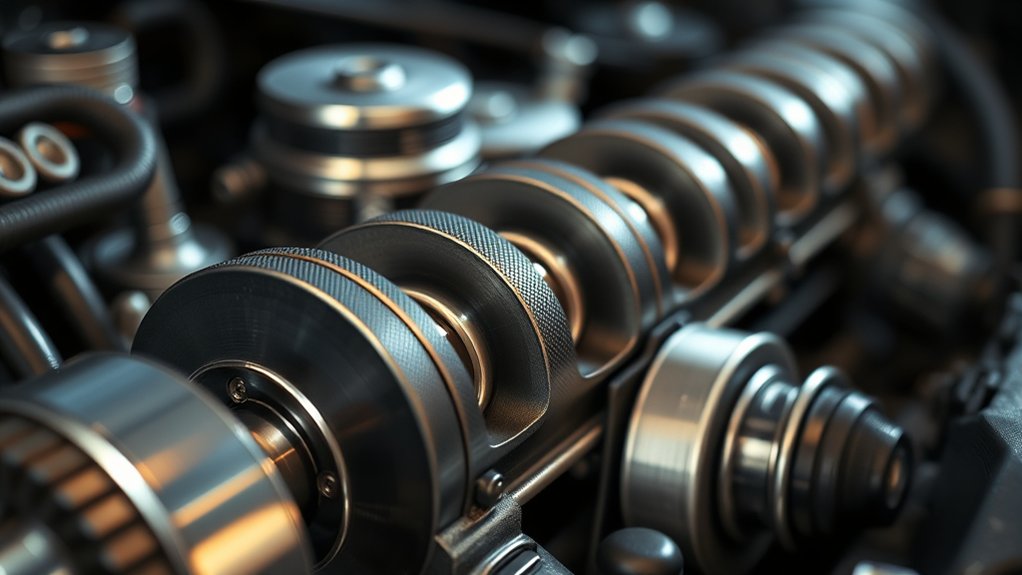
How exactly does a cam shaft influence fuel efficiency and emissions in an engine? Cam shafts control the timing and duration of valve openings, directly affecting air-fuel mixture intake and exhaust gas expulsion.
By optimizing valve lift and timing, cam shafts ensure more complete combustion, which enhances fuel efficiency and reduces unburned fuel emissions. Advanced cam shaft designs, such as variable valve timing (VVT), adjust valve operation based on engine load and speed, improving fuel economy under varying conditions.
If valve timing is off, it can cause incomplete combustion, increasing carbon monoxide and hydrocarbon emissions. Therefore, precise cam shaft profiles are crucial for balancing power output with reduced fuel consumption and lower pollutant release, making them a key component in meeting stringent emission standards while maximizing fuel efficiency.
7 Signs Your Cam Shaft Is Failing
You’ll notice unusual engine noises, like ticking or knocking, if your cam shaft is failing. These sounds occur because worn lobes or bearings disrupt valve timing.
Additionally, expect a noticeable drop in engine performance and power as the cam shaft’s ability to control valve operation declines.
Unusual Engine Noises
When does an engine noise signal a cam shaft problem? You’ll usually hear specific sounds from the engine bay that indicate cam shaft wear or failure. Ignoring these noises can lead to costly damage, so sticking to your maintenance schedule is essential.
Listen for these four key noises:
- Ticking or tapping sounds: Often caused by worn cam lobes or lifters.
- Knocking noises: Result from improper valve timing due to camshaft issues.
- Rattling: Can indicate a loose or damaged camshaft gear.
- Grinding: Suggests severe camshaft bearing wear or damage.
If you detect any of these, inspect the cam shaft promptly to avoid further engine damage. Regularly checking the engine bay during scheduled maintenance helps catch these issues early.
Performance and Power Loss
Notice a sudden drop in engine responsiveness or a sluggish throttle response? These symptoms often point to issues with the cam shaft. The camshaft controls valve timing, so any degradation can disrupt airflow and fuel combustion, leading to reduced performance and power loss.
Poor camshaft lubrication accelerates wear on lobes and journals, causing timing inconsistencies. Additionally, deviations from manufacturing tolerances, whether from wear or defects, affect cam profile accuracy, altering valve lift and duration. This misalignment reduces engine efficiency, directly impacting power output.
If your vehicle experiences these signs, inspect the camshaft for wear patterns, lubrication quality, and dimensional accuracy. Early detection helps prevent severe engine damage and restores optimal performance by ensuring the camshaft operates within precise manufacturing tolerances and maintains proper lubrication.
What Happens When Your Cam Shaft Wears Out?
How does a worn cam shaft affect your engine’s performance? When the camshaft wears out, it disrupts the precise timing and valve operation your engine relies on. This wear often results from insufficient camshaft lubrication or deviations beyond manufacturing tolerances, accelerating surface degradation.
A worn camshaft disrupts precise valve timing, often caused by poor lubrication or manufacturing deviations.
You’ll notice:
- Reduced valve lift and duration, impairing air-fuel mixture flow.
- Erratic valve timing, causing misfires and rough idling.
- Increased friction and heat due to surface wear, risking further damage.
- Decreased engine efficiency and power output as valve events lose precision.
Worn cam lobes alter valve motion profiles, compromising combustion quality. Maintaining strict camshaft lubrication and adhering to tight manufacturing tolerances is critical to prevent these performance losses.
Cam Shaft Inspection and Replacement Process
Why is regular camshaft inspection essential for engine longevity? Because early detection of wear or damage prevents costly failures. Start by removing the valve cover and inspecting lobes and journals for scoring or pitting.
Use a micrometer to measure camshaft lobes, comparing results against manufacturer tolerances. Pay close attention to lubrication challenges; lack of oil film can cause accelerated wear despite advanced camshaft manufacturing processes.
If you find excessive wear or damage, replacement is necessary. During replacement, ensure the new camshaft matches OEM specifications to maintain timing and performance.
Proper reassembly includes applying assembly lube to prevent initial startup wear. Finally, verify timing belt or chain alignment to avoid operational issues.
This precise inspection and replacement process ensures your camshaft operates reliably and extends engine life.
Cam Shaft Upgrades: Key Considerations
When considering camshaft upgrades, what factors should you prioritize to optimize engine performance and reliability? Upgrading your camshaft requires careful evaluation to ensure improved cam timing and prevent issues like oil sludging. Focus on these key considerations:
- Cam Profile Compatibility – Select a cam profile that matches your engine’s intended RPM range and power goals without compromising drivability.
- Material and Coating – Opt for high-quality materials and anti-friction coatings to reduce wear and resist oil sludging buildup.
- Cam Timing Adjustability – Choose an upgrade that allows fine-tuning cam timing for optimal valve events and combustion efficiency.
- Valve Train Clearance – Verify that upgraded cam lobes maintain proper clearance to prevent mechanical interference and premature wear.
Addressing these points ensures your camshaft upgrade maximizes performance without sacrificing engine longevity.
Frequently Asked Questions
Can a Cam Shaft Be Repaired or Only Replaced?
You can sometimes opt for cam shaft repair if damage is minor, like polishing or regrinding. However, severe wear or cracks usually require cam shaft replacement to guarantee precise valve timing and engine performance.
How Does Cam Shaft Noise Differ From Other Engine Noises?
You’ll hear a distinct tapping rhythm, like a steady drum, caused by worn camshaft lubrication or valve timing interaction issues. Unlike random engine clatters, camshaft noise is precise, reflecting mechanical wear in critical timing components.
What Tools Are Needed for Cam Shaft Installation?
You’ll need camshaft tools like a torque wrench, camshaft holding tool, timing gear puller, and dial indicator. These precision tools ensure accurate alignment and secure installation tasks, preventing engine timing issues and ensuring optimal performance.
Are Cam Shafts the Same in Electric Vehicles?
Think of cam design as a sculptor’s tool. Electric vehicles don’t need it since electric motors control valve timing electronically.
How Does Cam Shaft Design Vary in Motorcycles Versus Cars?
You’ll find motorcycle camshaft materials often prioritize lightweight alloys, while cars use heavier-duty steel. Manufacturing tolerances in motorcycles are tighter for high RPM precision, whereas car camshafts balance durability with broader tolerances for varied engine loads.
Conclusion
When your cam shaft starts showing its age, it’s like the conductor losing rhythm in an orchestra—valves mistime, and engine harmony fades. You’ll want to catch these subtle signals early, ensuring the heart of your valve train stays precise and well-lubricated.
Regular checks and timely replacements keep your engine’s performance sharp and efficient. This lets every rotation translate into smooth, powerful motion without missing a beat.
In the end, maintaining a healthy cam shaft is key to preserving the overall function and efficiency of your engine.