Did you know that a single half shaft can endure thousands of torque cycles during typical driving?
The half shaft plays a crucial role in transferring engine power from the differential to each wheel, making its design critical.
It must handle complex movements from steering and suspension while maintaining consistent torque delivery.
Understanding how it achieves this balance reveals why it’s indispensable for your vehicle’s performance and control.
Key Takeaways
- A half shaft transfers engine torque from the differential to the wheel hub.
- It connects the gearbox output to the wheels while allowing suspension movement.
- Half shafts use CV joints to transmit power smoothly at varying angles.
- They differ from driveshafts by being shorter and positioned between differential and wheels.
- Half shafts enable vehicle motion by maintaining consistent torque during steering and suspension changes.
What Is a Half Shaft and How Does It Work?
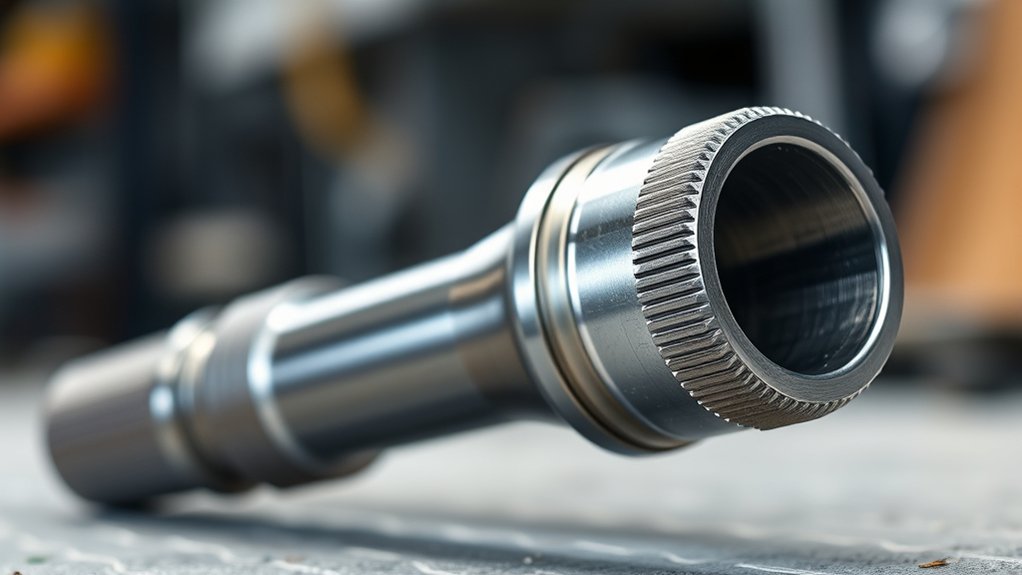
How does a half shaft function within a vehicle’s drivetrain? You rely on it to transfer engine torque from the differential to the wheels, converting rotational power into forward motion.
The half shaft connects the gearbox output to the wheel hub, allowing power delivery while accommodating suspension movement. Its design must balance strength and flexibility to withstand torsional stress without compromising drive reliability.
Constant velocity (CV) joints at each end enable smooth torque transmission even when the wheels turn or the suspension articulates. Without a properly functioning half shaft, torque delivery becomes inconsistent, leading to vibrations or drivetrain failure.
In essence, the half shaft is a critical component ensuring stable, efficient power transfer, directly impacting vehicle performance and safety through its role in maintaining consistent drive reliability.
How Does a Half Shaft Differ From Other Drive Components?
Where does the half shaft stand in relation to other drivetrain components? Unlike the driveshaft or axle shaft, the half shaft directly connects the differential to the wheel hub, transmitting torque effectively. Here’s how it differs:
- Position: Half shafts operate between the differential and wheels, while driveshafts link the transmission to the differential.
- Flexibility: Half shafts incorporate constant velocity (CV) joints to accommodate suspension movements; driveshafts generally don’t.
- Length: Half shafts are shorter, designed for each wheel, unlike a single long driveshaft.
- Function: Half shafts handle rotational force at varying angles, crucial for steering and suspension articulation.
Understanding these distinctions helps you grasp the half shaft’s specific role among other drive components, emphasizing its unique mechanical design and functional importance.
Why Is the Half Shaft Vital for Your Vehicle’s Movement?
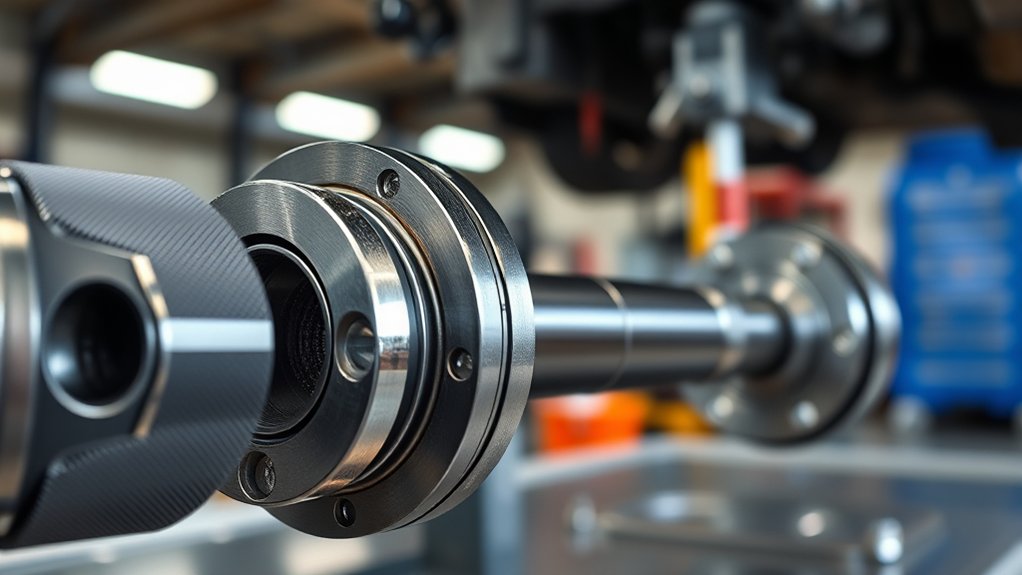
Having established the half shaft’s distinct role between the differential and wheel hub, it’s clear that this component directly influences your vehicle’s ability to move efficiently. The half shaft transmits torque generated by the engine through the drivetrain to the wheels, enabling motion.
Without it, power delivery would be incomplete, breaking the mechanical link essential in drivetrain basics. It also accommodates suspension movement and steering angles via constant velocity (CV) joints, maintaining consistent torque transfer under varying conditions. This ensures smooth acceleration and stable vehicle control.
How Can You Tell If Your Half Shaft Is Failing?
When does a failing half shaft start affecting your vehicle’s performance? You’ll notice symptoms emerge subtly at first, often masked by handling stealth. Key indicators include:
- Vibrations during acceleration, signaling joint wear or imbalance.
- Clicking noises when turning, caused by deteriorated CV joints.
- Visible rust damage on the shaft, compromising structural integrity.
- Difficulty steering or inconsistent handling due to compromised torque transfer.
These signs suggest the half shaft can’t efficiently transfer power from the transmission to the wheels, degrading your vehicle’s stability and control. Early detection is crucial because rust damage accelerates failure, and hidden handling stealth issues may escalate rapidly.
Monitoring these technical symptoms helps you address half shaft problems before they jeopardize safety or cause further drivetrain damage.
What You Need to Know Before Replacing a Half Shaft
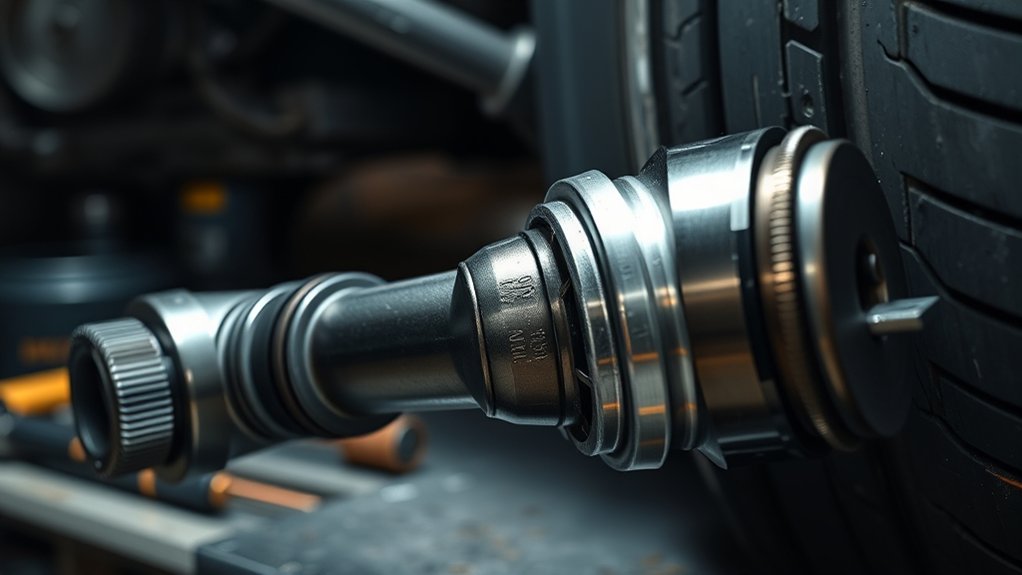
Recognizing the signs of a failing half shaft is only part of the process; understanding what to consider before replacing it guarantees a successful repair. Before starting, ensure you identify the exact half shaft causing the issue. Mixing up components or addressing the wrong direction of torque transfer can lead to ineffective repairs.
Avoid diverting attention to an unrelated topic, such as unrelated suspension parts, which wastes time and resources. Carefully assess the condition of surrounding components like CV joints and boots to prevent premature failure. Confirm compatibility with your vehicle’s make and model, as half shafts vary in length and spline count.
Finally, prepare for proper torque specifications and alignment during installation to maintain drivetrain integrity and avoid subsequent damage.
Frequently Asked Questions
What Materials Are Half Shafts Typically Made From?
Half shafts are typically made from steel alloys or carbon fiber composites, balancing materials and durability. You’ll find that steel offers better repairability, while composites simplify installation but may reduce long-term durability under stress.
Can Half Shafts Be Repaired or Only Replaced?
You can attempt half shaft repair if damage is minimal, but often replacement options provide better reliability. Analyze wear carefully; replacement typically ensures optimal performance and safety, especially when joints or shafts show significant deterioration or structural issues.
How Long Does a Half Shaft Usually Last?
You’ll typically get 70,000 to 130,000 miles from a half shaft. Rare spark or engine glow issues don’t directly affect its lifespan, but consistent inspection ensures you catch wear before performance or safety degrade markedly.
Are Half Shafts the Same in Front-Wheel and Rear-Wheel Drive Cars?
No, half shafts differ between front-wheel and rear-wheel drive cars. Front axles in front-wheel drive vehicles combine steering and power delivery, while rear-wheel drive uses separate drive shafts. This affects design and function considerably.
What Tools Are Needed to Install a Half Shaft?
Installing a half shaft is like assembling a puzzle; you’ll need a socket set, torque wrench, pry bar, and hammer. Staying focused on idea one ensures topic relevance, avoiding unrelated discussion that complicates this precise mechanical task.
Conclusion
Now that you know how a half shaft harnesses and handles horsepower, you’ll appreciate its pivotal role in providing precise power passage to your wheels. When worn or weakened, it wobbles and whines, warning you of impending failure.
Don’t delay detection or replacement—maintaining your half shaft means mastering motion and maintaining mechanical might. Stay sharp, spot signs swiftly, and secure smooth, seamless steering and suspension performance every time you turn.
Remember, the health of your half shaft is essential for optimal vehicle function and safety.