Think of the prop shaft as the unsung backbone of your vehicle’s drivetrain—it transmits torque from the transmission to the differential, enabling your wheels to move. The prop shaft is essential for transferring power smoothly and efficiently.
Without it, power flow would be interrupted, and your vehicle wouldn’t function properly. But what exactly allows this component to handle complex movements and maintain smooth power delivery under varying conditions?
Understanding this is key to recognizing why proper maintenance can’t be overlooked.
Key Takeaways
- A prop shaft transmits torque from the engine or transmission to the vehicle’s wheels or differential.
- It consists of a tubular shaft and universal joints that accommodate angular movement during driving.
- Prop shafts maintain continuous power delivery despite suspension movement and chassis flex.
- Proper alignment and material choice affect vibration, durability, and overall drivetrain performance.
- The term “prop shaft” is commonly used in British English and marine contexts, similar to “driveshaft” in American automotive terms.
What Is a Prop Shaft and Why It Matters
What exactly does a prop shaft do, and why should you care? A prop shaft transmits torque from the engine to the wheels, enabling your vehicle to move efficiently.
A prop shaft transfers engine torque to the wheels, making your vehicle move smoothly and efficiently.
You might have encountered prop shaft myths suggesting it’s a simple, unimportant component, but that’s far from true. Its design and material affect vibration, durability, and power delivery.
Similarly, universal joint myths often downplay their critical role in accommodating angular changes during motion, which prevents drivetrain damage. Understanding these misconceptions helps you appreciate the precision engineering behind your vehicle’s drivetrain.
If you ignore prop shaft and universal joint integrity, you risk costly failures and compromised performance. Knowing what a prop shaft truly does ensures you maintain your vehicle correctly and optimize its reliability.
How a Prop Shaft Works in Your Vehicle
You rely on the prop shaft to transfer torque from the engine to the wheels efficiently. It consists of key components like universal joints and a tubular shaft that work together to handle rotational forces and accommodate movement.
Understanding how these parts function helps you grasp how power moves seamlessly through your vehicle’s drivetrain.
Power Transmission Mechanism
How does a prop shaft efficiently transfer power within your vehicle’s drivetrain? It transmits rotational force from the transmission to the differential, maintaining torque under varying angles and distances.
Unlike an unrelated topic or off topic discussion, this mechanism is critical for continuous power delivery despite suspension movement or chassis flex. The prop shaft’s design ensures minimal energy loss through precise alignment and balanced rotation.
It compensates for angular displacement using universal joints, allowing smooth torque transfer even when the driveshaft isn’t perfectly straight. By rotating at engine speed, the prop shaft maintains consistent power flow, driving the wheels effectively.
Understanding this mechanism clarifies how power reaches your vehicle’s wheels reliably, without interruptions caused by dynamic driving conditions or changing geometries.
Components and Functionality
The prop shaft consists of several key components such as the tubular shaft, universal joints, and splines that work in unison to transmit torque efficiently between the transmission and differential. The tubular shaft forms the main body, providing structural integrity and torque transfer.
Universal joints accommodate angular misalignments, maintaining rotational power despite changes in drivetrain alignment during vehicle movement. Splines connect the shaft to transmission and differential, allowing for axial movement and absorbing vibrations.
When comparing prop shafts, consider materials, joint types, and length to match vehicle specifications precisely. Proper drivetrain alignment ensures the prop shaft operates without excessive stress or wear, preventing premature failure.
Understanding these components and their functionality helps you diagnose issues and select the correct prop shaft for optimal drivetrain performance.
Prop Shaft vs. Driveshaft: What’s the Difference?
You’ll notice that “prop shaft” and “driveshaft” are often used interchangeably, but they have distinct terminology based on regional and technical contexts.
Understanding their functional roles clarifies how each transmits torque differently depending on the vehicle’s design. Let’s analyze these differences and how usage varies across automotive applications.
Terminology Differences Explained
Why do some people use “prop shaft” while others say “driveshaft”? The terminology differences stem largely from regional preferences and industry contexts. In British English and marine engineering, “prop shaft” specifically refers to the shaft transmitting torque to a propeller.
In contrast, “driveshaft” is the more common term in American English, especially in automotive applications, describing the shaft that delivers rotational power from the transmission to the differential. Understanding these nuances is essential, so if you’re updating a technical glossary, be precise about context and audience.
A glossary update should clarify that while both terms describe similar mechanical components, their usage varies by domain and geography. This distinction ensures accurate communication in technical documentation and engineering discussions.
Functional Roles Compared
How do prop shafts and driveshafts differ in their functional roles within mechanical systems? Understanding prop shaft terminology is crucial here. A prop shaft primarily transmits torque between components such as the transmission and differential, often over longer distances.
Driveshafts, while sometimes used interchangeably with prop shafts, generally refer to shorter, more specific components within the driveline. The distinction lies in their placement and mechanical demands.
From a driveline safety perspective, recognizing these roles helps you identify potential stress points and maintenance needs. Prop shafts must withstand torsional forces and misalignment over extended spans, whereas driveshafts often deal with rotational speed and balance.
Misapplying terminology can lead to oversight in safety protocols and component selection, compromising system integrity. Thus, precise understanding of both terms enhances your control over driveline design and safety.
Usage In Various Vehicles
Where do prop shafts and driveshafts typically appear across different vehicle types? Prop shaft terminology often distinguishes between rear-wheel-drive cars, trucks, and all-wheel-drive vehicles.
In rear-wheel-drive setups, the prop shaft transfers torque from the transmission to the rear differential, critical for efficient power delivery. Meanwhile, driveshafts in front-wheel-drive vehicles tend to be shorter, connecting the transaxle to the wheels.
When analyzing drivetrain aesthetics, you’ll notice that off-road and heavy-duty trucks prioritize robust prop shafts to withstand torque fluctuations, influencing both design and maintenance. In contrast, sports cars use lighter materials for their driveshafts to optimize performance and reduce rotational mass.
Understanding these distinctions helps you appreciate how vehicle design adapts prop shaft configurations to balance durability, efficiency, and visual integration within the drivetrain system.
Different Types of Prop Shafts You Should Know
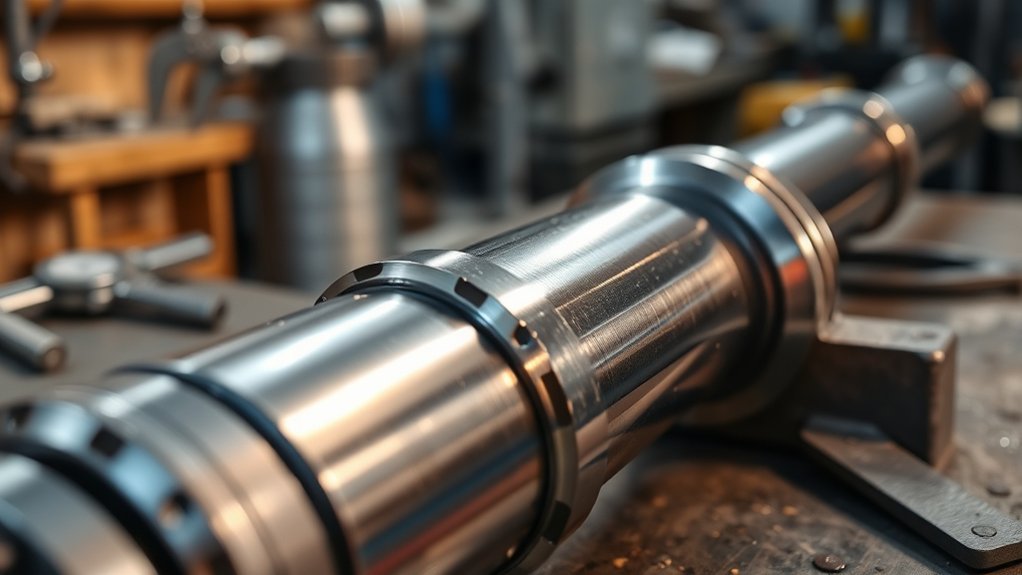
Which type of prop shaft suits your application best depends on factors like torque capacity, length, and flexibility requirements. You’ll encounter several types, including tubular, solid, and slip prop shafts.
Tubular shafts offer high strength-to-weight ratios, ideal for applications demanding flexibility without compromising torque transmission. Solid shafts provide maximum durability but may add unwanted weight.
Tubular shafts balance strength and flexibility, while solid shafts maximize durability at the cost of added weight.
Slip prop shafts accommodate changes in length due to suspension movement, ensuring consistent exhaust alignment and preventing stress on connected components. Certain designs integrate features for irreversible steering, enhancing directional control by preventing back-driving under load.
When selecting, consider the operational environment and mechanical constraints to optimize performance and longevity. Your choice directly impacts drivetrain efficiency, vibration damping, and vehicle handling characteristics, so analyze these parameters carefully before finalizing the prop shaft type.
Signs Your Prop Shaft Needs Repair
When should you consider inspecting your prop shaft for potential damage? Key signs include unusual vibrations, clunking noises, and difficulty in power transmission. A timely prop shaft inspection can prevent further drivetrain issues.
| Symptom | Possible Cause | Inspection Focus |
|---|---|---|
| Vibrations at speed | Imbalance or bend | Shaft straightness |
| Clunking noises | Universal joint wear | Joint articulation play |
| Power loss | Shaft misalignment | Alignment and coupling |
Pay close attention to universal joint wear during your prop shaft inspection. Excessive play or rust can indicate imminent failure. Address these signs promptly to maintain drivetrain integrity and vehicle safety.
Common Causes of Prop Shaft Failure
Why do prop shafts fail prematurely? You’ll find that improper alignment is a primary cause, increasing stress on the shaft and leading to fatigue cracks. Additionally, insufficient lubrication accelerates wear on components, causing surface degradation and eventual failure.
Corrosion, often overlooked, weakens the shaft material, especially in harsh environments. Overloading the shaft beyond its design limits introduces excessive torque, resulting in deformation or breakage.
It’s important not to confuse these technical causes with an unrelated topic or random discussion, such as general vehicle issues, which don’t directly impact prop shaft integrity. By understanding these precise failure mechanisms, you can better diagnose problems and prevent premature prop shaft damage, ensuring your drivetrain operates reliably and efficiently.
How Universal Joints Keep Your Prop Shaft Working
How do universal joints maintain the functionality of your prop shaft under varying angles and motion? Universal joints accommodate angular misalignment between the transmission and differential, allowing your prop shaft to transmit torque smoothly despite changes in driveline geometry.
Universal joints enable smooth torque transmission by compensating for angular misalignment in the driveline.
They enable rotational power transfer at variable angles without binding or excessive stress. By permitting flexibility, universal joints reduce strain on connected components and prevent drivetrain damage.
Vibration analysis plays a crucial role in monitoring these joints’ condition; irregular vibrations often indicate wear or imbalance, signaling impending failure. Properly functioning universal joints ensure consistent rotational velocity, minimizing torsional vibrations that can degrade prop shaft performance.
Understanding the mechanics and vibration characteristics of universal joints helps you maintain driveline integrity and optimize your vehicle’s operational reliability.
How to Maintain Your Prop Shaft for Longevity
To ensure your prop shaft delivers consistent performance and extends its service life, you must perform regular inspections and maintenance focused on critical components like universal joints, splines, and bearings.
Idea one involves routinely lubricating these parts using the manufacturer-recommended grease to reduce friction and prevent wear. Idea two emphasizes checking for signs of corrosion or play, which can indicate early failure.
| Maintenance Task | Frequency |
|---|---|
| Lubricate joints | Every 5,000 miles |
| Inspect splines | Every 10,000 miles |
| Check bearing condition | Every oil change |
When to Consult a Mechanic About Your Prop Shaft
When should you involve a mechanic in prop shaft issues? Understanding prop shaft terminology and recognizing driveshaft differences is crucial for timely professional intervention. If you encounter any of the following signs, consult a mechanic promptly to avoid costly damage:
- Unusual vibrations or shuddering during acceleration or deceleration
- Audible clunking or knocking noises near the transmission or differential
- Excessive play or visible wear in universal joints or center bearings
- Leakage of grease or oil around prop shaft seals
- Difficulty in steering or noticeable drivetrain binding
Addressing these symptoms early ensures proper diagnosis and repair, preserving drivetrain integrity. Since prop shafts differ from driveshafts in design and function, a mechanic’s expertise in these distinctions can prevent misdiagnosis and optimize vehicle performance.
Frequently Asked Questions
Can a Prop Shaft Be Customized for Off-Road Vehicles?
Yes, you can customize a prop shaft for off-road vehicles to enhance off-road durability. By selecting stronger materials and precise engineering, you’ll improve torque handling and resistance, ensuring reliable performance under extreme off-road conditions.
What Materials Are Commonly Used to Manufacture Prop Shafts?
Materials exploration mostly means metals like steel, aluminum, and carbon fiber. Manufacturing techniques prioritize precision, balancing strength and weight.
You’ll find each material offers specific advantages, ensuring your prop shaft performs efficiently under diverse driving demands.
How Does Temperature Affect Prop Shaft Performance?
You’ll find temperature effects notably impact prop shaft performance; excessive heat reduces heat tolerance, causing material expansion and weakening structural integrity. This leads to increased wear, vibration, and potential failure under operational stresses.
Are There Eco-Friendly Alternatives to Traditional Prop Shafts?
You know what they say: “A stitch in time saves nine.” You can choose eco-friendly alternatives like composite or recycled materials to reduce environmental impact, enhancing durability and efficiency while minimizing carbon footprints in propulsion systems.
Can Prop Shafts Be Recycled or Reused After Damage?
You can explore recycling options for damaged prop shafts, but repair viability depends on damage extent and material integrity. Ensuring structural soundness guarantees safe reuse; otherwise, recycling recovers valuable metals, minimizing environmental impact efficiently.
Conclusion
Your prop shaft is the unsung hero of your vehicle’s powertrain, quietly transferring torque like a well-oiled relay runner. Neglecting its maintenance invites vibrations, clunks, and costly failures that disrupt your ride.
By understanding its function, recognizing warning signs, and ensuring regular inspections, you keep this critical component spinning smoothly. Don’t let a worn prop shaft throw a wrench in your plans—stay proactive, and your drivetrain will reward you with reliable performance.
Remember, taking care of your prop shaft is essential to maintaining the overall health and efficiency of your vehicle.