You might assume that shaft horsepower directly reflects the power available for work, but it actually tells a more precise story. Shaft horsepower measures the actual usable power delivered to a system’s output shaft, factoring in losses that engine horsepower overlooks.
Understanding this distinction is essential for accurately evaluating mechanical efficiency and performance, especially when precise power delivery matters. So, how exactly is shaft horsepower defined and determined?
Key Takeaways
- Shaft horsepower (shp) measures the actual power delivered by an engine to the output shaft after drivetrain and mechanical losses.
- It accounts for friction, gear engagement, and accessory loads, reflecting usable mechanical power rather than raw engine output.
- SHP is calculated using torque and RPM with the formula HP = (Torque × RPM) / 5252.
- It provides a practical metric to assess engine efficiency, wear, and real-world performance across automotive, marine, and industrial applications.
- Shaft horsepower differs from brake and engine horsepower by including transmission losses, offering a more realistic measure of power delivered.
What Is Shaft Horsepower?
What exactly is shaft horsepower, and why does it matter? Shaft horsepower (shp) measures the actual power delivered by an engine to the output shaft, accounting for power losses within the drivetrain. When you evaluate shaft horsepower, you’re focusing on usable power after internal friction, gear engagement, and accessory loads reduce the engine’s raw output.
Understanding shp helps you analyze engine wear since excessive friction or poor lubrication increases mechanical resistance, lowering shaft horsepower. Monitoring shaft horsepower thus provides insight into the engine’s health and efficiency.
How Is Shaft Horsepower Different From Brake and Engine Horsepower?
Shaft horsepower focuses on the power actually delivered to the output shaft, but it’s important to distinguish this from brake horsepower and engine horsepower, which represent different stages of power measurement. Engine horsepower measures the theoretical power produced within the combustion chamber, without losses.
Brake horsepower accounts for power loss through ancillary components like the alternator and water pump, measured at the engine’s output shaft before transmission losses. Shaft horsepower, however, quantifies power after transmission and drivetrain losses, reflecting usable mechanical output.
Understanding these distinctions helps you avoid maintenance myths suggesting power improvements without addressing drivetrain efficiency. Furthermore, grasping these differences influences fuel economics by ensuring you evaluate real-world performance rather than idealized engine output, allowing for more accurate assessments of efficiency and operational costs.
How Is Shaft Horsepower Measured and Calculated?
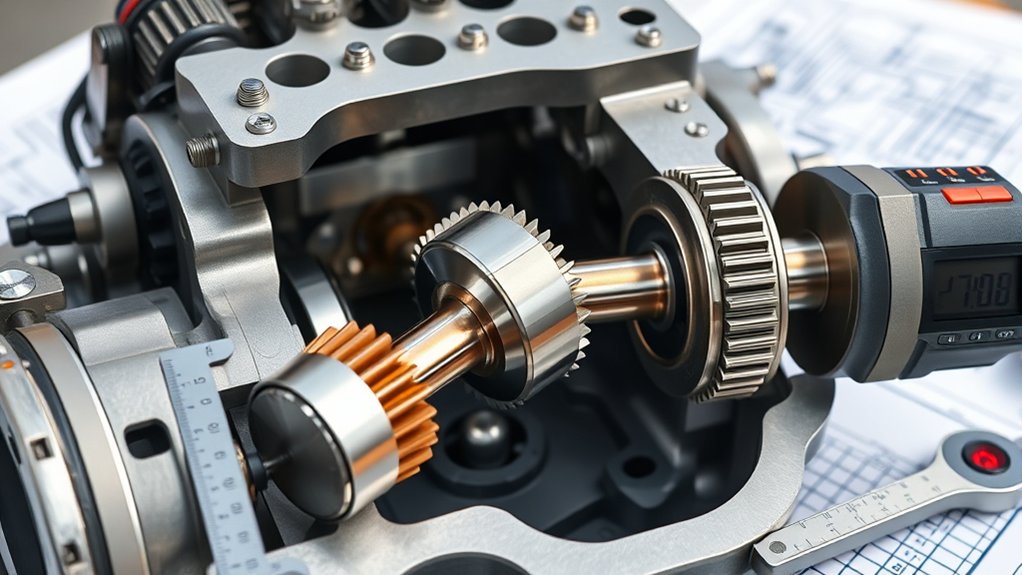
To measure shaft horsepower accurately, you first need to record the torque and rotational speed (RPM) of the shaft. You’ll then apply the formula HP = (Torque × RPM) / 5252 to calculate the horsepower.
Using calibrated tools like torque meters and tachometers guarantees precision in both measurement and calculation.
Measuring Torque and RPM
How do you accurately measure torque and RPM to determine shaft horsepower? First, ensure torque stability by using a calibrated torque transducer that captures consistent, real-time torque values without fluctuation. This stability is crucial because transient torque spikes can distort measurements.
Meanwhile, closely monitor RPM ramp rates to avoid rapid changes that may introduce errors. Gradual RPM increases allow you to record steady-state data, improving measurement reliability. Use precise sensors or tachometers for RPM, synced with torque data acquisition systems to capture simultaneous readings.
Calculating Shaft Horsepower Formula
What formula do you use to translate torque and RPM into shaft horsepower? The standard calculation is:
[
text{Shaft Horsepower (SHP)} = frac{text{Torque (lb-ft)} times text{RPM}}{5252}
]
This formula converts rotational force and speed into power output, vital for assessing fuel efficiency and planning maintenance scheduling.
| Parameter | Description |
|---|---|
| Torque (lb-ft) | Rotational force applied |
| RPM | Rotations per minute |
| 5252 | Constant for unit conversion |
| SHP | Shaft horsepower output |
Using this formula, you can precisely determine engine output, enabling optimized fuel consumption and timely maintenance to avoid performance degradation.
Tools for Accurate Measurement
Understanding the formula for shaft horsepower sets the stage for accurate measurement techniques. To measure shaft horsepower precisely, you’ll rely on a dynamometer, which directly assesses torque and rotational speed. This data, combined with the formula, calculates shaft horsepower reliably.
Precise engine selection plays a critical role, ensuring the power output matches operational requirements. Additionally, the gearbox design affects torque transmission and must be factored into measurements to avoid inaccuracies caused by mechanical losses.
Torque sensors and tachometers provide real-time data essential for analysis, enabling you to quantify power output under varying load conditions. By integrating these tools with a thorough understanding of engine and gearbox parameters, you can achieve accurate, repeatable shaft horsepower measurements vital for performance optimization and system diagnostics.
What Factors Reduce Shaft Horsepower?
Why does shaft horsepower often fall short of its theoretical maximum? You must consider turbine losses, which include aerodynamic inefficiencies and friction within turbine components, reducing the mechanical energy transferred to the shaft.
Turbine losses like aerodynamic inefficiencies and friction reduce the mechanical energy reaching the shaft.
Additionally, imperfect shaft alignment plays a critical role; even minor misalignments cause increased friction and vibration, leading to energy dissipation that directly lowers shaft horsepower. Wear and tear on bearings and seals further contribute to power loss by increasing resistance.
Thermal losses in the drivetrain and gearbox inefficiencies compound these reductions. To maintain optimal shaft horsepower, you need to minimize these factors through precise engineering, regular maintenance, and alignment verification.
Understanding and mitigating turbine losses and shaft alignment errors allows you to maximize the actual power delivered by the engine shaft.
Why Does Shaft Horsepower Matter for Aircraft and Marine Engines?
You need to understand shaft horsepower because it directly measures an engine’s efficiency in converting fuel into usable mechanical power. This metric is critical for optimizing power transmission to propellers or rotors, ensuring maximum performance.
Engine Efficiency Measurement
Although shaft horsepower (shp) directly measures the usable power delivered by an engine to a propeller or drivetrain, its significance extends beyond raw output figures. You use shp to evaluate engine efficiency, linking mechanical output to internal combustion processes.
By comparing shp with fuel input, you can assess combustion efficiency, how effectively fuel energy converts into mechanical work. Additionally, shaft horsepower reflects the combined effects of engine lubrication quality and internal friction losses.
Poor engine lubrication increases friction, reducing the power transmitted to the shaft and lowering overall efficiency. Monitoring shp allows you to detect performance degradation due to lubrication issues or suboptimal combustion.
Therefore, shaft horsepower serves as a practical metric to gauge real-world engine efficiency, providing insight into mechanical and thermodynamic performance essential for aircraft and marine applications.
Power Transmission Importance
Understanding shaft horsepower’s role in power transmission reveals its direct impact on aircraft and marine engine performance. You need to grasp that shaft horsepower quantifies the actual mechanical power delivered through the engine’s output shaft, factoring in power loss from internal friction and auxiliary components.
When you consider gear ratio, it becomes clear how torque and rotational speed adjust to optimize propulsion efficiency. A mismatched gear ratio can increase power loss, reducing effective thrust or thrust equivalent.
For aircraft and marine engines, where precise power delivery ensures safety and fuel economy, shaft horsepower offers a reliable metric to evaluate performance beyond raw engine output. By focusing on shaft horsepower, you can more accurately assess how well the engine converts fuel energy into usable mechanical power at the propeller or rotor interface.
What Are Real-World Examples of Shaft Horsepower?
Where do you encounter shaft horsepower in everyday machinery? Real-world examples abound in application-focused contexts like automotive drivetrains, marine propulsion, and industrial equipment.
When you drive a car, the engine’s shaft horsepower directly powers the transmission shaft, translating engine output into wheel movement. Similarly, in marine environments, shaft horsepower measures the power delivered from the engine to the propeller shaft, critical for vessel speed and efficiency.
Industrial machines like pumps, compressors, and generators also rely on shaft horsepower to quantify the mechanical power transmitted through rotating shafts. Understanding these examples helps you appreciate how shaft horsepower serves as a precise metric in power transmission, enabling engineers and operators to optimize performance and ensure mechanical efficiency across various technical applications.
How Can You Use Shaft Horsepower to Compare Engine Performance?
How do you objectively evaluate and compare the performance of different engines? You use shaft horsepower as a standardized metric reflecting the actual power delivered to the output shaft after accounting for losses in power transmission.
By measuring shaft horsepower, you assess the engine efficiency in converting fuel energy into usable mechanical power. This allows you to compare engines beyond theoretical calculations like brake horsepower, which don’t consider drivetrain losses.
Measuring shaft horsepower reveals true engine efficiency by accounting for power losses beyond brake horsepower estimates.
When comparing two engines, consider their shaft horsepower at similar operating conditions; higher shaft horsepower indicates superior engine efficiency and effective power transmission.
This approach helps you analyze real-world performance, ensuring your comparison accounts for practical power output rather than just raw engine potential. Shaft horsepower thus serves as a critical parameter in performance evaluation and selection.
Frequently Asked Questions
Can Shaft Horsepower Be Converted to Kilowatts?
Yes, you can convert shaft horsepower to kilowatts by applying conversion basics. Since 1 horsepower equals approximately 0.7457 kilowatts, you’ll perform a unit comparison to multiply shaft horsepower by this factor for accurate power measurement conversion.
What Maintenance Affects Shaft Horsepower Output?
Think of your engine like a marathon runner. Without proper maintenance checks and strict lubrication schedules, it’ll tire quickly, reducing shaft horsepower output.
Regular upkeep ensures peak performance, preventing power loss and mechanical wear effectively.
How Does Altitude Impact Shaft Horsepower?
You’ll notice altitude effects reduce shaft horsepower because thinner air decreases engine efficiency.
To manage power rating tradeoffs, you must adjust engine settings or accept lower performance when operating at higher altitudes.
Are There Industry Standards for Shaft Horsepower Ratings?
Yes, industry standards define shaft horsepower concept definitions precisely, ensuring consistent rating methods across manufacturers. You’ll find these standards in technical documents like SAE and ISO, which establish measurement protocols and performance benchmarks for accuracy and comparability.
Can Shaft Horsepower Indicate Engine Fuel Efficiency?
You might assume shaft horsepower directly reflects engine efficiency, but it doesn’t. Instead, it measures mechanical output, while fuel economy depends on combustion quality, load, and design.
Conclusion
When you compare engines, shaft horsepower gives you the real story—power delivered after losses. It’s like measuring the water flowing out of a pipe, not just what’s coming in. Understanding SHP helps you gauge true efficiency and performance, whether in aircraft or marine engines.
So next time you evaluate power, remember: the number that matters is what actually turns the shaft, not just what the engine claims on paper. This is why shaft horsepower is the key metric to focus on for accurate power assessment.